

A featured contribution from Leadership Perspectives: a curated forum reserved for leaders nominated by our subscribers and vetted by the Construction Tech Review Advisory Board.

CSS Corp
Understanding the dynamics of a Project Manager

Kiran Marri
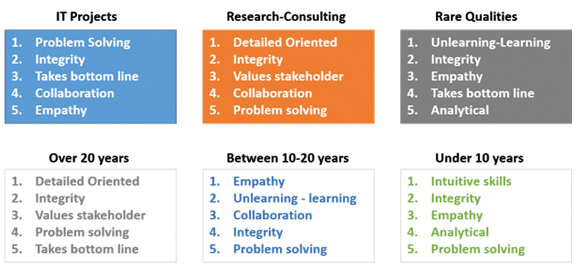 Figure 3: Project dynamics in appraise-appraiser situations
Project execution is highly dynamic in nature, and changes are the only constants that one needs to manage. Similar projects assigned to the same team at different time periods have shown such as higher productivity or lower cost expectations. Understanding the dynamics of a project is one of the key elements for success. Project dynamics include combination of scope, environment, technology, stakeholders, constraints, deliverables, and business expectations. Processes, tools, and measurements have become an integral part of projects as they control the dynamics in a structured manner, and they should be adjusted, calibrated and made suitable, based on the complexity of projects.
Some of the myths on project management and about project managers are:
▪ There is only one possible way to manage a specific type of project
▪ A specific way of management will work in most of the situations, environment and people
▪ A project manager who has successfully delivered one project (or few projects) can repeat the same success (or levels of successful measures) across every other type of projects
▪ Good managers are also good leaders
▪ Good leaders are also good managers
In a recent report from Harvard Business Review, it was stated that there are 4 types of managers (Prophets, Gamblers, Experts, Executors) in all organizations, based on reliable business case and growth opportunity in the line of existing strategy. However, one often comes across managers who fail due to multiple reasons. One of the dimensions of failure is the interpersonal conflicts between the individual (manager) and their reporting manager. In this article, an alternate category for a manager is proposed namely: Inactive (a misfit or a person who in far behind current times), Reactive (has sufficient or limited knowledge but performs based on triggers or direction), Preactive (has sufficient knowledge and can reasonably forecast, and uses sufficient skills to view what is next) and Proactive (has wisdom to create the path and designs future that is best for the stakeholders). The inactive and reactive types usually have a “doer” attitude by nature, and the pre-active and proactive types have qualities of “leader”. The interpersonal conflicts in the hierarchy system is driven by the nature of two individuals, and this can influence the structure and functioning of the business or the organization. Figure 1 is a representative hierarchy structure with different combinations of “nature” of individuals. Leaders usually reach out to people at different levels and the doers are people who create hurdles. The dynamics of such projects is influenced by these individuals and their inherent nature. Thus, it is important to have an ideal structure to minimize the ‘doer-leader’ alignment. The matrix is represented in Figure 2, and the representative dynamics of the projects are shown in Figure 3. Within any organization, it is important to identify the “doers” and ensure that a balanced structure is maintained at all levels.
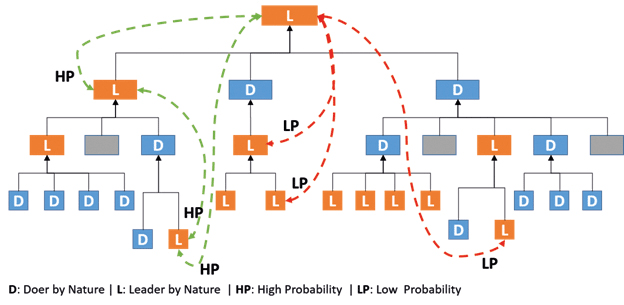
Figure 1: Representative Hierarchy Structure with “nature” of the managers
A survey was conducted across different individuals from 14 organizations (IT companies, Government organization, Research Institutes) covering people who have over 450 years of experience to understand the characteristics of good-great manager and qualities that distinguishes them. The group of respondents were categorized into nature of work (IT Projects and Research-Consulting Projects) and based on their experience (over 20 years, between 10-20 years, under 10 years). It is observed that integrity, collaboration, and problem solving skills are very important and are of top quality among IT projects and research-consulting streams. However, it is also observed that unlearning-learning, integrity and empathy are the rarest attributes found among managers. Similarly, across the age groups, three qualities that was selected among 20 attributes were integrity, problem solving and empathy.
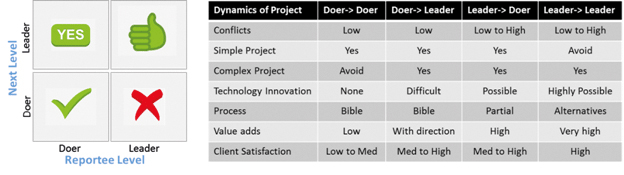
Figure 2: Doer-Leader Matrix
It can be concluded that project dynamics are highly complex and contextual. While it is a challenge to get project managers with 15 different best skills quoted above, but maybe it is better to have a manager who can see the big picture, get deep into details, connect with people to get the best from each individual, and willingness to learn, and owns the project. A successful project manager is one who has eye for detail as a detective, analyzes data points as a statistician, gets the best from the team members as a coach, learns as a student and asks the right questions as a child.
